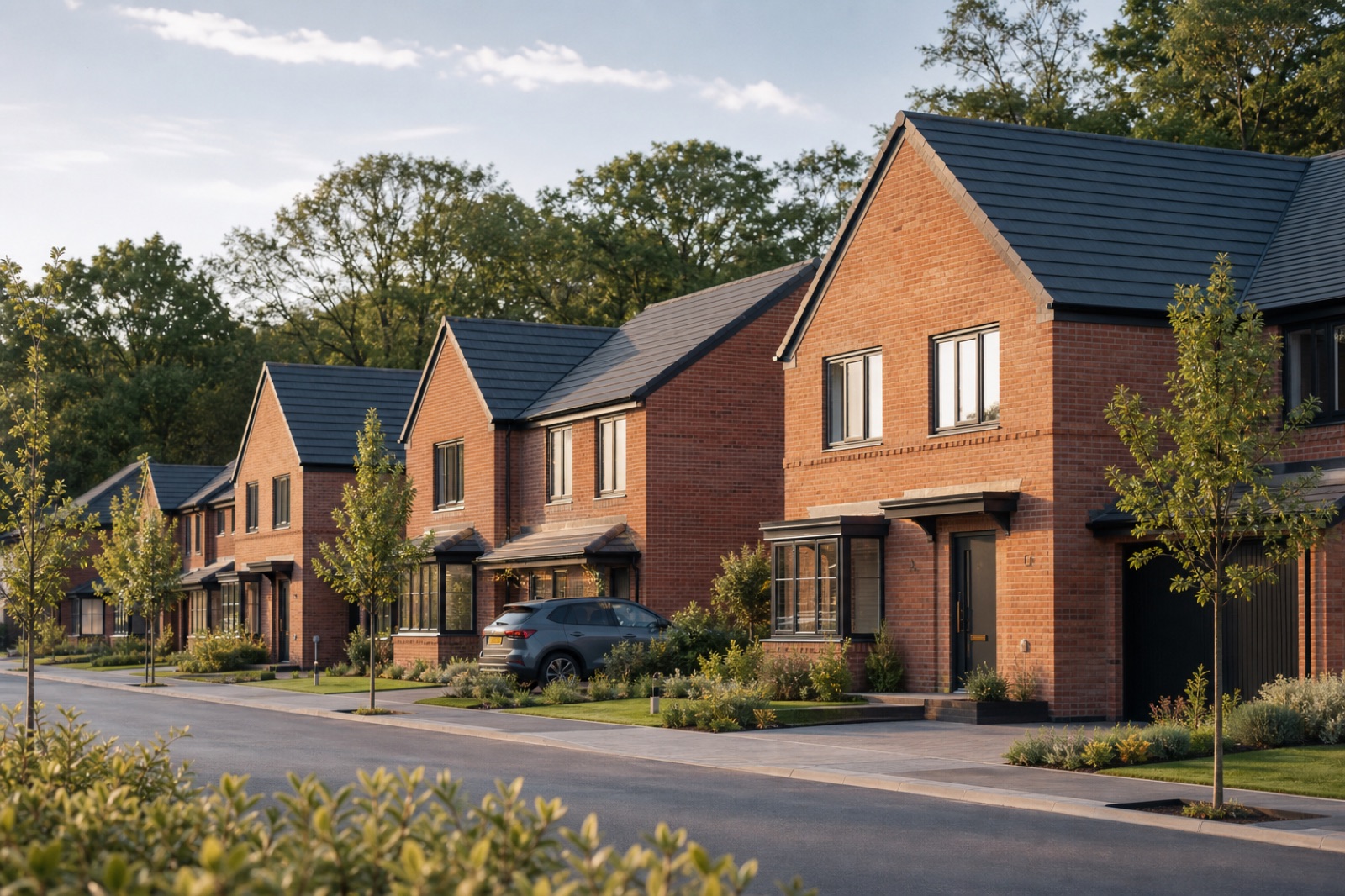
Single family build to rent finance for housing schemes
We arrange development and investment finance for single-family housing build to rent: whole streets and estates of houses built to let to families. This is business lending against a development scheme and its rental income, not a personal mortgage.

Funding single-family housing
Single-family housing, or SFH, means houses rather than flats built to rent, with whole streets or estates let to families and held as a single rental asset under one operator. It is the fastest-growing segment of UK build-to-rent, and in 2025 it overtook multifamily apartments on investment for the first time. The product suits family demand, suburban and edge-of-town sites, and a phased delivery profile that lets a developer build and let in tranches.
When we say single family build to rent finance we mean the development facility, forward-funding line or stabilised investment loan used to fund a housing scheme as a portfolio of let homes. Lenders read it through the gross development value, the build cost, the net operating income across the estate, and the prime SFH net initial yield, with the phased build and lease-up shaping the cash-flow profile.
An SFH scheme often de-risks a wider site: a housebuilder can sell a tranche of plots to a single rental buyer, or build out a rental estate alongside homes for sale. The funding mirrors the multifamily arc, senior development debt to around 60 to 65% of cost with mezzanine and equity toward 70 to 75% of GDV, but the phased completion of houses changes how lease-up and the rent roll build.
We are an arranger and introducer, not a lender. We package the scheme, the operator and the numbers so development lenders and institutional SFH funders can price the risk, and we run the whole market rather than relying on a single relationship.
What we fund
- Single-family housing estates built to rent
- Whole-street and tranche rental housing schemes
- Ground-up SFH development finance to completion
- Forward-funded single-family housing for institutional buyers
- Rental plots de-risking a housebuilder's wider site
- Stabilised single-family housing investment finance
Indicative terms
- Loan to cost (LTC)Senior to around 60 to 65% of cost
- Loan to GDV (LTGDV)Around 70 to 75% with mezzanine
- Investment LTVUp to around 65% of stabilised value
- BasisSized on GDV, build cost, rent roll and SFH yield
- DeliveryPhased build and lease-up across the estate
- Key testsGDV, LTC, LTGDV, NOI, DSCR, lease-up
- ExitInvestment refinance or institutional sale
Indicative only. Terms vary by lender, operator and home and are not an offer of finance.
How we fund single-family housing schemes
We fund single-family housing on the same development arc as multifamily, with the phased delivery of houses built in. For a ground-up estate we model the gross development value, the build cost and the net operating income across the let homes, then arrange senior development finance to around 60 to 65% of loan to cost, with mezzanine and equity toward 70 to 75% of loan to GDV. Because houses complete and let in tranches, the rent roll builds progressively, so lenders test loan to cost through the build and size debt service against the stabilising net operating income and a target DSCR. Where an institutional SFH buyer is in place, forward funding can carry the build in return for the completed, let estate. Once the scheme stabilises, a development exit or investment loan re-prices the debt onto the rent roll. Every figure is indicative and never an offer; the terms depend on the GDV, the SFH yield and the operator covenant, and we run the market to find them.
Lender appetite for single family build to rent
Single-family housing draws fast-growing appetite, because institutional capital has moved decisively into the segment. Development lenders such as Shawbrook, OakNorth, United Trust Bank, Secure Trust Bank and Paragon fund SFH estates on loan to cost and loan to GDV, while institutional funders forward fund or acquire completed rental estates that value to a prime SFH yield. Knight Frank put prime single-family housing net initial yields at 4.00% in the South East and 4.50% regionally in September 2025, with the outlook hardening as demand rises. Single-family housing made up about 59% of UK BTR investment in 2025 at around £3.17bn (Savills), with Knight Frank putting the share at 55% on its basis, the first year SFH overtook apartments. As an arranger and introducer with no exclusive tie, we match the scheme and the operator to the funder most comfortable with SFH delivery rather than defaulting to one lender.
The single family build to rent market and exit
Single-family housing is the fastest-growing part of UK build-to-rent. Savills recorded single-family investment of about £3.17bn in 2025, roughly 59% of all BTR investment, the first year houses overtook apartments, while Knight Frank put the share at 55% on its basis. The South East is the SFH heartland, where Knight Frank put prime yields at 4.00% with the outlook hardening, against 4.50% regionally. The wider sector reached 298,800 homes complete, under construction or in planning at Q4 2025 (Savills), and family rental demand is underpinned by an English house-price-to-earnings ratio of 7.7x in 2024 (ONS) that locks would-be buyers into renting. A completed, well-let rental estate valuing to a prime SFH yield is a sought-after institutional asset, which gives a development lender confidence in the exit. We structure the funding with that sale or refinance in view.
Finance that suits this scheme
- Single-family housing financePurpose-built debt for ground-up SFH rental estates and whole-street schemes.
- BTR development financeSenior development debt to fund the build of a single-family rental scheme.
- Forward fundingAn institutional SFH buyer funds the build in return for the completed estate.
- BTR investment financeLong-term debt against the stabilised rent roll once the estate is let.
Fund a single-family housing scheme
A view on fundability within one working day.
What drives a single-family housing scheme's numbers
A single-family housing scheme's economics turn on the gross development value of the estate against the build cost, and the net operating income across the let homes, with the phased completion of houses shaping how the rent roll builds. Lenders take the gross rent across the estate, strip out the gross-to-net operating costs of roughly 25 to 35% of gross rent, and capitalise the NOI at a prime SFH net initial yield. Knight Frank put prime single-family housing yields at 4.00% in the South East and 4.50% regionally in September 2025, with the outlook hardening as institutional demand rises. Because houses let in tranches, the NOI stabilises progressively, so lenders test loan to cost through the build and size debt service against the stabilising rent roll. Family rental demand is durable, underpinned by an English house-price-to-earnings ratio of 7.7x in 2024 (ONS) that keeps would-be buyers renting. We model the phased rent roll and the realistic gross-to-net, because that is what supports the debt.
Indicative single-family housing leverage and rates
Indicatively we arrange single-family housing development finance with senior debt to around 60 to 65% of loan to cost, and mezzanine and equity toward 70 to 75% of loan to GDV, with the phased delivery of houses built into the drawdown and lease-up profile. Debt service is sized against the stabilising NOI and a target DSCR. Once the estate completes and lets, a stabilised investment loan re-prices the debt onto the rent roll, typically to around 65% of stabilised value. A scheme valuing to a keen SFH yield, with a credible operator and strong family demand, earns the keener end, and the hardening yield outlook supports value. Forward funding from an institutional SFH buyer can carry the build in return for the completed estate. These are market-typical, indicative figures and never an offer; the terms depend on the GDV, the SFH yield and the operator, and we run the market across development and institutional lenders.
Frequently asked questions
What is single family build to rent?
Single-family housing, or SFH, is houses rather than flats built to rent, with whole streets or estates let to families and held as a single rental asset under one operator. It is the fastest-growing part of UK build-to-rent, and in 2025 it overtook multifamily apartments on investment for the first time, reaching about 59% of BTR investment per Savills. We arrange development and investment finance against the scheme, not personal income.
How is single-family housing finance different from multifamily?
The funding arc is similar, senior development finance to around 60 to 65% of cost with mezzanine toward 70 to 75% of GDV, but houses complete and let in tranches rather than as one block, so the rent roll builds progressively and the lease-up profile differs. Single-family housing also values to its own prime yield, which Knight Frank put at 4.00% South East and 4.50% regional in September 2025.
Why is single-family housing growing so fast?
Family rental demand is strong, suburban sites suit the product, and institutional capital has moved into it: single-family housing made up about 59% of UK BTR investment in 2025 at around £3.17bn (Savills), the first year it overtook apartments. An English house-price-to-earnings ratio of 7.7x in 2024 (ONS) keeps would-be buyers renting, which underpins the demand lenders and investors back.
Can a housebuilder sell rental plots to fund a wider site?
Yes. A housebuilder can sell a tranche of plots to a single SFH rental buyer, or build out a rental estate alongside homes for sale, which de-risks the wider site and brings forward cash. We arrange the development finance for the rental element and run the institutional market where a forward-funding or forward-commitment buyer is involved.
How does a single-family housing scheme exit its development loan?
Once the estate completes and lets, the development debt is repaid by a stabilised investment loan against the rent roll, a development exit facility, or a sale to an institutional buyer. A well-let rental estate valuing to a prime SFH yield is a sought-after asset, so the exit is usually a refinance onto keener terms or an institutional sale.
Funding a single-family housing scheme?
Tell us about the scheme and the operator and we will come back with a view on fundability and likely terms.