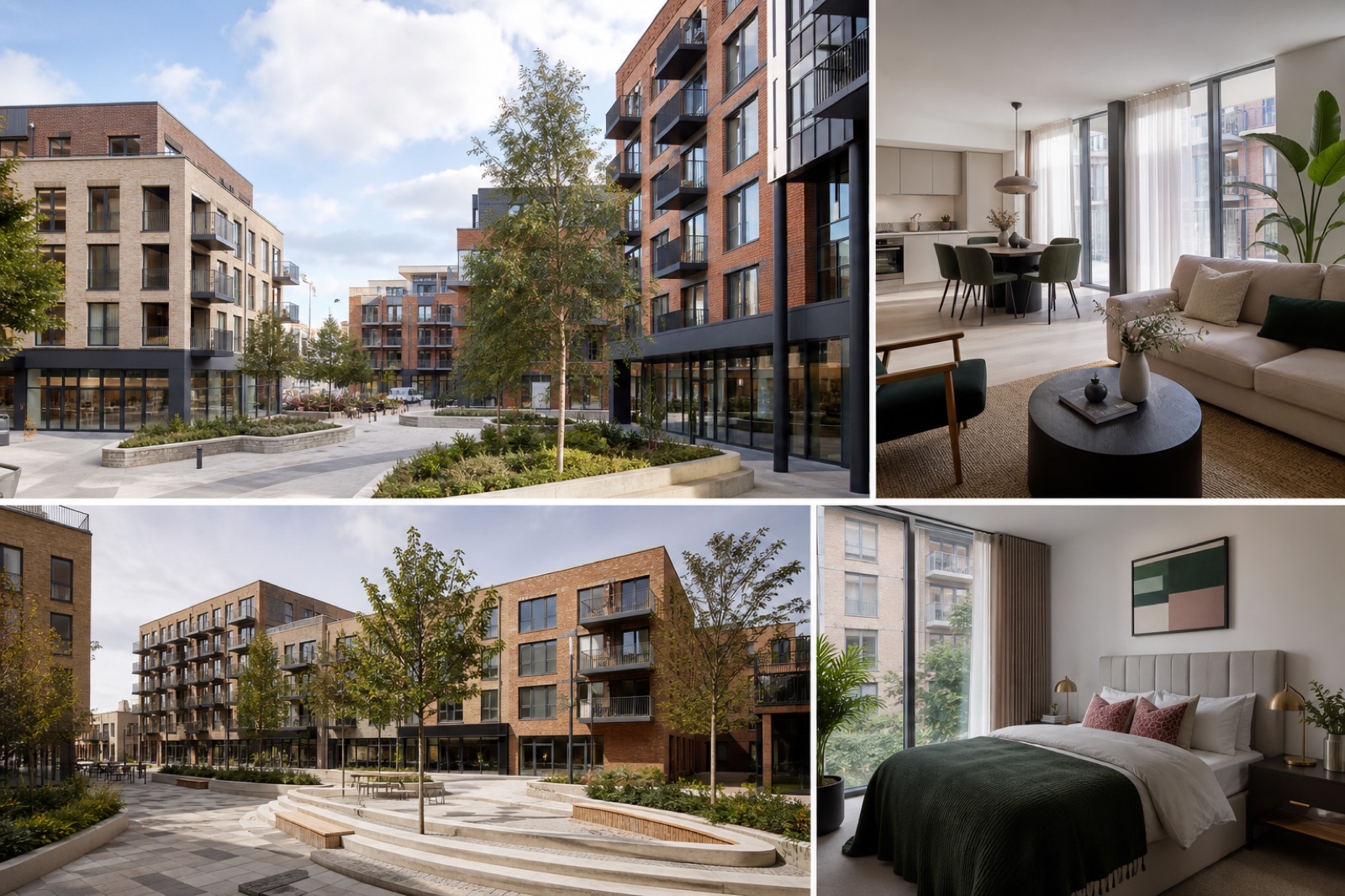
Mixed use development finance for regeneration schemes
We arrange development finance for larger regeneration and mixed-use schemes that combine build-to-rent with commercial, retail and public realm. This is business lending against a phased development, not a personal mortgage.

Funding mixed-use scheme
Regeneration and mixed-use schemes are the larger, phased developments that combine build-to-rent homes with commercial, retail, leisure and public realm, often on brownfield land and frequently delivered with a public-sector partner. They are the most complex BTR scheme type to fund, because they mix uses, run over several phases and carry planning and infrastructure obligations that a single-use block does not.
When we say mixed use development finance we mean the development facility, forward-funding line, mezzanine layer or phased funding structure used to deliver the scheme. Lenders read it through the gross development value of each component, the build cost, the residential net operating income and yield, the commercial rental income, the phasing plan and the planning consent, including any Section 106 obligations, rather than a borrower's personal income.
Phasing is central. A regeneration scheme is rarely funded as one facility; it is structured phase by phase, with each tranche of homes and commercial space funded, built, let and refinanced before or alongside the next. Brownfield remediation, infrastructure, public realm and Section 106 affordable-housing obligations all sit in the cost plan and shape the loan to cost and loan to GDV a lender will advance.
We are an arranger and introducer, not a lender. We package the masterplan, the phasing, the operator and the numbers so development banks, debt funds and institutional funders can price the risk across the components, and we run the whole market rather than relying on a single relationship.
What we fund
- Brownfield regeneration schemes with a BTR component
- Mixed-use schemes combining BTR with commercial and retail
- Phased developments funded tranche by tranche
- Public-sector partnership and joint-venture regeneration
- Schemes carrying Section 106 affordable-housing obligations
- Forward-funded BTR plots within a wider masterplan
Indicative terms
- Loan to cost (LTC)Senior to around 60 to 65% of cost
- Loan to GDV (LTGDV)Around 70 to 75% with mezzanine
- BasisSized on phased GDV, build cost, NOI and yield
- PhasingFunded tranche by tranche across the masterplan
- ObligationsSection 106, infrastructure and remediation in the cost plan
- Key testsGDV, LTC, LTGDV, planning consent, phasing, DSCR
- ExitInvestment refinance or institutional sale per phase
Indicative only. Terms vary by lender, operator and home and are not an offer of finance.
How we fund regeneration and mixed-use schemes
We fund regeneration schemes phase by phase rather than as a single facility. For each tranche we model the gross development value of the residential and commercial components, the build cost including remediation, infrastructure and public realm, and the net operating income the BTR homes will produce once let, then arrange senior development finance to around 60 to 65% of loan to cost, with mezzanine and equity toward 70 to 75% of loan to GDV. Lenders read the planning consent closely, including any Section 106 affordable-housing obligations, because those commitments sit in the cost plan ahead of the developer's return. Where an institutional buyer takes the completed BTR plots, forward funding can carry that part of the build. Each phase is built, let and refinanced or sold before or alongside the next, so the structure recycles capital across the masterplan. Every figure is indicative and never an offer; the terms depend on the phasing, the GDV, the yield and the planning position, and we run the market to find them.
Lender appetite for mixed-use and regeneration finance
Regeneration and mixed-use schemes draw appetite from development lenders comfortable with complexity and scale. Development banks and debt funds such as Shawbrook, OakNorth, United Trust Bank, Paragon and Atelier fund phased schemes on loan to cost and loan to GDV, weighing the mix of uses and the strength of the residential and commercial income; institutional funders forward fund or acquire the completed BTR plots within the masterplan. Lenders favour a clear planning consent, a credible phasing plan and a residential component that values to a prime yield, Knight Frank put prime regional multifamily net initial yields at 4.50% Tier 1 and 4.75% Tier 2 in September 2025, with London at 4.25%. The West Midlands and North West are the deepest regional regeneration markets, with Birmingham's BTR pipeline up about 31% in 2025 (JLL). As an arranger and introducer with no exclusive tie, we match each phase and component to the funder most comfortable with it.
The regeneration and mixed-use market and exit
Regeneration is where much of the UK BTR pipeline sits. Savills recorded a total BTR sector of 298,800 homes complete, under construction or in planning at Q4 2025, with 101,500 in the planning pipeline, much of it on larger brownfield and mixed-use sites. City-centre regeneration drives the strongest regional pipelines: JLL put Birmingham's pipeline up about 31% in 2025, second only to London, and the North West around Manchester and Salford remains the deepest regional market. Net additional dwellings in England were 208,600 in 2024/25, below the 300,000 target (MHCLG), so the public-sector appetite for regeneration delivery is strong. Each completed phase, with its BTR homes valuing to a prime yield, is a liquid asset with a refinance or institutional-sale exit, which is what gives a development lender comfort on a phased scheme. We structure the funding with each phase's exit in view.
Finance that suits this scheme
- BTR development financeSenior development debt to fund each phase of a mixed-use regeneration scheme.
- Forward fundingAn institutional buyer funds the BTR plots within the wider masterplan.
- BTR mezzanine and equityTops up senior debt to reach a higher loan to GDV on complex schemes.
- Development exit financeBridges a completed phase to its sale or investment refinance.
Fund a mixed-use scheme scheme
A view on fundability within one working day.
What drives a regeneration scheme's numbers
A regeneration scheme's economics are about how a phased, mixed-use cost plan converts into value across its components. Lenders model the gross development value of the residential and commercial parts separately, the build cost including brownfield remediation, infrastructure and public realm, and the net operating income the BTR homes will produce once let, capitalised at a prime yield. Knight Frank put prime regional multifamily net initial yields at 4.50% Tier 1 and 4.75% Tier 2 in September 2025, with London at 4.25%, the benchmark for the residential component. The decisive variables are the phasing, the planning consent and any Section 106 affordable obligations, because those commitments sit in the cost plan ahead of the developer's return and govern how capital recycles across the masterplan. Much of the national pipeline sits on such sites: Savills recorded 101,500 BTR homes in planning at Q4 2025. We model each phase on its own GDV and cost, because that phase-by-phase picture is what supports the debt.
Indicative regeneration and mixed-use leverage and rates
Indicatively we arrange regeneration development finance phase by phase, with senior debt to around 60 to 65% of loan to cost on each tranche, and mezzanine and equity toward 70 to 75% of loan to GDV. Debt service is sized against the stabilising NOI of the BTR homes and a target DSCR, and the structure recycles capital as each phase is built, let and refinanced or sold. A clear planning consent, a credible phasing plan, a deliverable Section 106 position and a residential component valuing to a keen prime yield earn the keener end; unresolved planning or heavy obligations pull leverage back and may call for more equity. Forward funding from an institutional buyer can carry the BTR plots within the masterplan, and a development exit facility can bridge a completed phase to its sale. These are market-typical, indicative figures and never an offer; the terms depend on the phasing, the GDV, the yield and the planning position, and we run the market across the components.
Frequently asked questions
What is mixed use development finance for a regeneration scheme?
It is business lending used to deliver a larger phased scheme that combines build-to-rent homes with commercial, retail and public realm, often on brownfield land. It is sized on the gross development value of each component, the build cost including remediation and infrastructure, the residential net operating income and yield, the commercial income, the phasing and the planning consent. We arrange it phase by phase, not as a personal mortgage.
How is a phased regeneration scheme funded?
Tranche by tranche. A regeneration scheme is rarely funded as one facility; each phase of homes and commercial space is funded with senior development finance to around 60 to 65% of cost, plus mezzanine toward 70 to 75% of GDV, then built, let and refinanced or sold before or alongside the next. This recycles capital across the masterplan and keeps the leverage matched to each phase's risk.
How do Section 106 obligations affect the finance?
Section 106 affordable-housing and infrastructure obligations sit in the scheme's cost plan ahead of the developer's return, so lenders read the planning consent closely and size loan to cost and loan to GDV with those commitments accounted for. A clear, deliverable Section 106 position supports keener leverage; an unresolved or heavy obligation gives a lender pause and may call for more equity.
Can the BTR part of a mixed-use scheme be forward funded?
Yes. An institutional buyer can forward fund the build-to-rent plots within the masterplan, paying for that part of the build in return for the completed, let homes, which de-risks the residential component and brings forward capital. We arrange the development finance for the wider scheme and run the institutional market for the BTR plots.
Why are regeneration schemes harder to finance?
They mix uses, run over several phases, and carry planning, infrastructure, remediation and Section 106 obligations that a single-use block does not. That complexity means lenders underwrite each phase and component on its own merits, weigh the planning position closely, and structure the funding to recycle through the masterplan, which is why a clear consent and phasing plan are central to the terms.
Funding a mixed-use scheme scheme?
Tell us about the scheme and the operator and we will come back with a view on fundability and likely terms.